By Sydney S.
As we learned in Series I, plastic was never meant to be a temporary material. Its creators intended plastic to last for generations through products used daily like combs and telephones. Yet 50% of all plastic products produced are single-use.1 Single-use products serve only one purpose and are intended to be temporarily used before being discarded or (hopefully) recycled. While it seems simple to recycle plastics, this series will cover the rise of plastic use over time and the difficulties with the global recycling industry.
TYPES OF PLASTIC
Before questioning why recycling plastic isn’t more widespread, we have to remember there are many types of plastic. Plastic comes in so many forms the universal recycling triangle symbol with numbers was created so waste sorting plants could properly sort plastic into its respective types, such as polyethylene terephthalate (PET).
Method Recycling’s chart on the different types of plastic is a great visual of the variances between plastics and the products they comprise:

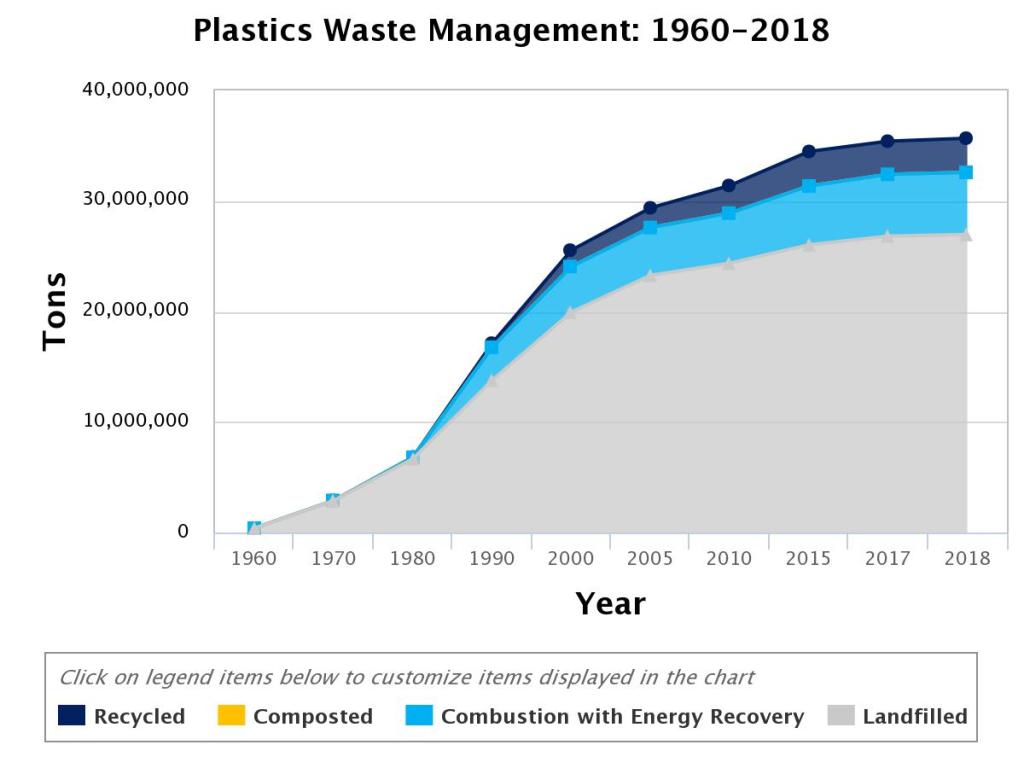
It’s easy to see how much we rely on plastic in our everyday lives, whether single-use or reusable. Plastic growth has surged over the last century, and the rise in plastic waste speaks for itself2:
- 1980: the U.S. generates 6,830,000 metric tons of plastic waste
- 2000: the U.S. generates 25,550,000 metric tons of plastic waste
- 2018: the U.S. generates 35,680,000 metric tons of plastic waste
And the U.S. is consuming more than our fair share of plastic. In 2016, the U.S. accounted for 4% of the global population, but generated 17% of the world’s plastic waste.3 But if we can recycle the thermoplastic we generate, why is plastic still such an issue? The truth is recycling is a flawed system.
RECYCLING PLASTIC
If you’re a consumer of plastic, chances are you make an effort to recycle the bottles, packaging, and containers you use. But your individual recycling efforts are just that – individual. According to the study “Production, use, and fate of all plastics ever made,” 9% of plastic is recycled, 12% is incinerated, 79% ends of in landfills or in nature.4 Similarly, the report “Breaking the Plastic Wave” found only 15% of plastics were recycled.5 It’s astonishing and disappointing to think the overwhelming majority of plastic ever produced still exists today.
If you’re wondering why so little plastic is recycled, there are a few reasons. First, curbside recycling was introduced in the U.S. in the late 1960’s, despite plastic being produced and disposed of decades prior. In fact, the City of Madison only began mandatory curbside recycling in 1991.6 Plastic products were either littered or sent to the landfill before the establishment of community drop-off sites and curbside recycling.
“Wishcycling” is proving to be detrimental to the recycling industry. Wishcycling is the practice of recycling products in the hopes that they are recyclable creates additional work for the waste management companies sorting our recyclables. According to Waste Management, 25% of the products placed in curbside recycling bins are actually contaminants that were wishcycled.7 These contaminants cost companies like Waste Management money because they must sort and dispose of them. Plastics cannot simply be combined together when creating new products. If different plastic resins are inadvertently combined after being compounded, the resins may separate and create a weak and unusable product.8 At worst, accidentally mixing different plastics can cause explosions and put the lives of production workers at risk.Lastly, despite plastics originating from fossil fuels, they are still cheap to produce. If the cost of petroleum rises, the cost of plastic rises as well, but the plastic recycling process is still expensive and difficult due to issues like wishcycling. Tim Gutowski, a mechanical engineering professor at MIT, said it best: “From the manufacturers’ point of view, oil’s a safer bet.”9 Because companies can produce and purchase “virgin” plastic for a cheaper overall price, it’s incredibly challenging to incentivize them to use recycled resins.
THE FLAWS WITH GLOBAL RECYCLING
Up until 2017, 70% of recycled plastics were exported to China.10 The Chinese government realized the environmental impacts of taking in so much plastic without the infrastructure to handle it, and largely banned imports beginning in 2018. According to the 2019 NPR article “Where Will Your Plastic Trash Go Now That China Doesn’t Want It?,” China accepted <1% of its 2016 total of plastic waste.10
After China’s ban, the U.S. began diverting plastic waste to other southeast Asian countries including Malaysia.11 But these countries already struggled with waste mismanagement; according to the 2015 study Plastic waste inputs from land into the ocean, Malaysia mismanages 57% of its waste in comparison to the U.S. mismanaging only 2%.12 The U.S. and other nations exporting plastic waste to third world countries who aren’t equipped to handle the volume. We are essentially passing the buck, keeping our own country’s environment “clean” while less developed countries suffer. The irony, of course, is that we are part of a larger global community – we all suffer.
Join us for Series III, the final installment of this series, to learn more about how plastic impacts the environment when it is mismanaged and what we as consumers and voters can do to reduce our dependence on plastic.
Sources:
1: https://www.unep.org/interactive/beat-plastic-pollution/
3: https://www.nationalgeographic.com/environment/article/us-plastic-pollution
4: https://advances.sciencemag.org/content/3/7/e1700782
5: https://www.pewtrusts.org/-/media/assets/2020/10/breakingtheplasticwave_distilledreport.pdf
6: https://www.cityofmadison.com/streets/recycling/history.cfm
7: https://mediaroom.wm.com/the-dangers-of-wishcycling/
8: https://www.thehour.com/news/article/Earthtalk-Why-can-t-plastics-all-be-melted-8120040.php
12: https://www-jstor-org.ezproxy.uwsp.edu/stable/pdf/24746131.pdf?ab_segments=0%2Fbasic_search_gsv2%2Fcontrol&refreqid=fastly-default%3A9cfa597d039719f6bf3bdc37d81f2319
Additional References:
 Sustainable Saplings
We all have a stake in the sustainable use of plastics.
From a monetary side, we invest in companies via our portfolios not understanding their position with regards to sustainability. We ask/demand that those investments provide the highest returns to improve our personal standards of living.
So to accomplish that end they need to sell more product/services. The marketing departments and packaging engineers design packaging to accomplish higher sales. In most cases without a concern for environmental impact, or at best the impact is at the end of the list. What most don’t see is that the higher cost of easily recycled materials is discarded, due mainly to the premium cost over other materials.
Because if its nicely packaged it must be a great item. (The fallacy in “perception is reality”) But thats a whole other discussion.
I encourage you to look for “root cause”,continue to share your message, and promote your site!!
Consider targeting collegiate programs in marketing and engineering with your message.
It does have an impact, gets people thinking, and affects purchases that directly and indirectly coincide with your cause.
Keep up the great work!
Bob
Formerly with two oo’s
LikeLike
Thank you so much Bob for your response! You are absolutely right! It really comes down to what is the “true cost” of plastic. Just because we do not know how to monetize pollution and environmental degradation in relation to dollar values does not mean we get to write off the cost of the items impact.
LikeLike